


GFRP REBAR FOR
DAMS & HYDRAULIC INSTALLATIONS
Engineered to Withstand Water’s Power.
Durable reinforcement for extreme hydraulic conditions.




Corrosion
Resistant
Water
Resistant
Longer Lifespan
Less Thermal
Expansion
What are Dams & Hydraulic Structures?
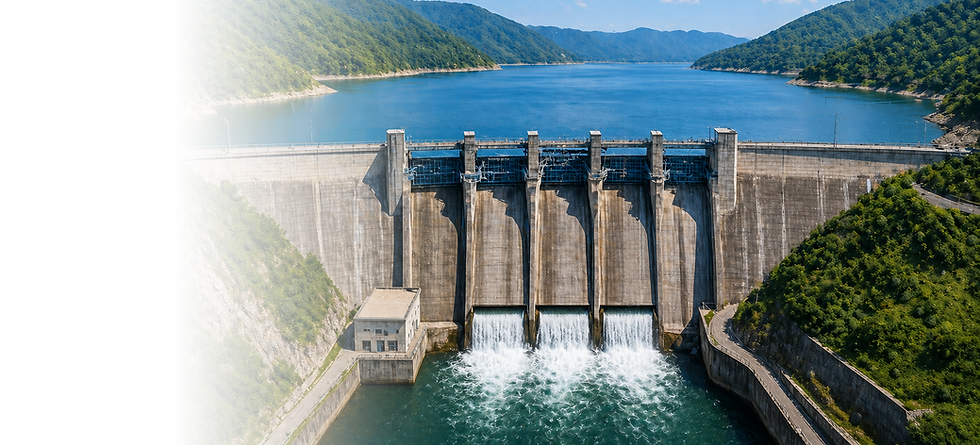
Dams and hydraulic structures are critical infrastructure systems designed to store, control, and manage water resources. These include dams, spillways, canals, reservoirs, water treatment plants, barrages, and other water-retaining or water-conveying structures.
Such structures are continuously exposed to water pressure, flow dynamics, moisture, and environmental factors, making durability and long-term performance essential. They often operate under demanding conditions where structural integrity is crucial for safety, efficiency, and uninterrupted operation.
The Need for Specialised Reinforcement
Reinforcement in hydraulic structures must withstand:
-
Constant exposure to water and moisture
-
Chlorides, sulphates, and dissolved chemicals in water
-
Hydrostatic pressure and cyclic loading from water flow
-
Freeze-thaw cycles and temperature variations (in certain regions)
Traditional steel reinforcement, while strong, is highly susceptible to:
-
Corrosion due to continuous water exposure
-
Cracking and spalling of concrete caused by rust expansion
-
Frequent maintenance and repair requirements
-
Reduced lifespan and increased operational costs
In large-scale water infrastructure, these issues can lead to serious structural risks and high maintenance expenses, creating a need for a more durable and reliable reinforcement solution.
Why GFRP is Ideal for Dams & Hydraulic Structures?
GFRP (Glass Fiber Reinforced Polymer) rebars provide a modern solution specifically suited for water-related infrastructure.
1. Complete Corrosion Resistance
GFRP does not rust or corrode, even under:
-
Continuous water immersion
-
Exposure to chlorides and salts
-
Chemically aggressive water conditions
This eliminates one of the most critical failure mechanisms in hydraulic structures.
2. Superior Durability in Wet Environments
GFRP maintains its structural properties over time, making it ideal for:
-
Dams and spillways
-
Canal linings and reservoirs
-
Water treatment and storage facilities
3. Enhanced Structural Longevity
Without corrosion-related degradation:
-
Concrete remains intact without cracking due to rust expansion
-
Structures achieve significantly longer service life
-
Reduced risk of premature failure
4. Reduced Maintenance and Lifecycle Costs
Hydraulic structures are often difficult and expensive to repair. GFRP offers:
-
Minimal maintenance requirements
-
Elimination of corrosion protection systems
-
Lower long-term operational costs
5. High Tensile Strength
GFRP provides excellent tensile reinforcement, helping to:
-
Resist hydrostatic and dynamic water loads
-
Control cracking in concrete structures
-
Maintain structural stability over time
6. Lightweight and Easy Handling
GFRP rebars are much lighter than steel, enabling:
-
Easier transportation to remote or large-scale sites
-
Faster installation
-
Reduced labour and equipment requirements
Why GFRP is Better than Steel for Dams & Hydraulic Structures
Factor | Steel Reinforcement | GFRP Reinforcement |
|---|---|---|
Corrosion Resistance | Prone to rust in water | Completely corrosion-free |
Durability in Wet Conditions | Degrades over time | Long-lasting performance |
Maintenance | High | Minimal |
Structural Life | Limited | Extended (50-100+ years) |
Lifecycle Cost | High | Lower |
Performance in Chemicals | Limited | Excellent |
Dams and hydraulic structures demand materials that can withstand continuous water exposure, chemical attack, and long-term loading without degradation. GFRP rebars eliminate the primary limitations of steel by offering corrosion-free performance, enhanced durability, and extended service life, making them an ideal reinforcement solution for modern water infrastructure projects.